
Here's what makes us different! Four benefits of expanding into Hyogo

Access
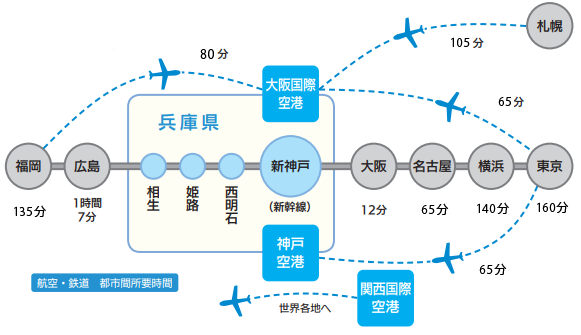
Hyogo-Kobe is located almost in the center of Japan, making it very convenient to travel within the country by train, plane, expressway, etc. For example, by train, you can reach Tokyo in about 160 minutes (by Shinkansen) and Osaka, Japan's second largest city, in just about 20 minutes (by conventional line). Expressways also connect Tokyo, Nagoya, Osaka, and Kobe in almost a straight line, and a network of expressways is developed crisscrossing Hyogo Prefecture.Also,Kobe AirportIt connects to 11 domestic cities, including Tokyo (Haneda) and Sapporo (New Chitose), and 5 international cities (as of March 2026). Osaka International Airport(Itami City, Hyogo Prefecture), Kansai International AirportThere are air routes from here to major cities in the country, allowing for speedy access to all parts of the country.
Logistics Infrastructure
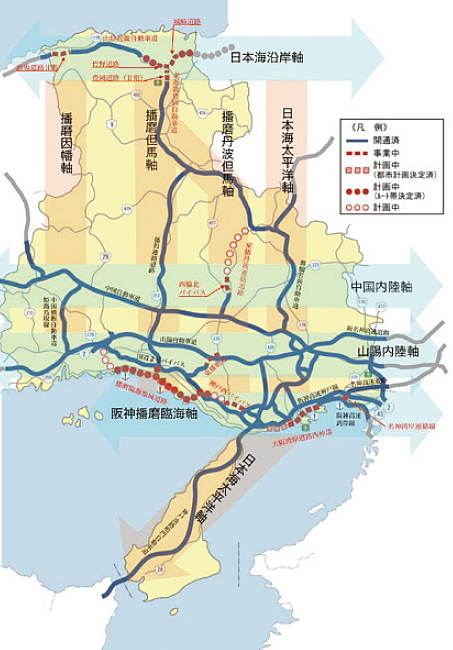
【road】Expressways covering the vast prefecture - Eight trunk roads connecting the prefecture
In Hyogo Prefecture, where major roads such as the Chugoku Expressway and the Sanyo Expressway run east-west through the prefecture, the prefecture is promoting the development of "eight linked trunk road axes" consisting of four east-west and four north-south main axes.
The Maizuru Expressway, Kobe Awaji Naruto Expressway, Bantan Link Road, and other roads have already been constructed running north-south, and these roads connect with the Chugoku Expressway and Sanyo Expressway, making Hyogo Prefecture the leading transportation hub in western Japan.
[Shipping]
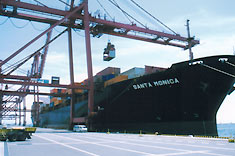 Functioning as an international container strategic port, offering a wide range of services
The Port of Kobe, which has been selected as one of Japan's strategic international container ports along with the Port of Osaka, has 12 terminals capable of handling containers, and its container berths are equipped with the world's largest gantry cranes and other cutting-edge cargo handling machinery, enabling safe and efficient cargo handling operations.
Port Island Phase 2 will be a state-of-the-art comprehensive logistics base, featuring a deepwater, high-standard container terminal with a depth of 15-16 meters, which will be the main facility for the international container strategic port, as well as extensive wharf land and land for port logistics functions.
Himeji Port is also the main port of the Harima Industrial Zone, and is characterized by its energy supply base for petroleum products and electricity, as well as its steel and lumber yards. Amagasaki, Nishinomiya, and Ashiya Ports are logistics and production bases located adjacent to large cities. Higashi-Harima Port has a hinterland with production spaces for steel, chemical products, and many processing and assembly industries, and like Himeji Port, it functions as a main port of the Harima Industrial Zone.
[Aviation]
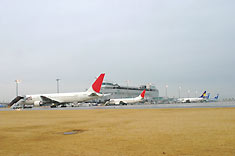 Expanding the international air network
Kansai International Airport, Japan's leading airport, is open 24 hours a day and is an offshore airport that takes into consideration the conservation of the natural environment. It is connected to 55 cities in 20 countries (regions) around the world (as of May 2024) and 15 cities in Japan (as of May 2024). It is directly connected to the prefectural capital of Kobe via the Hanshin Expressway Bayshore Route, making it a gateway for international air transport.
In August 2007, a second runway was opened, making it the first international airport in Japan to meet world standards with multiple 4,000m-class runways and 24-hour operation.
Furthermore, Osaka International Airport, located in the center of the Keihanshin metropolitan area, is positioned as a core airport for domestic flights and serves as an air terminal for the surrounding area.
Furthermore, Kobe Airport, which opened in February 2006, is located approximately 18 minutes from Sannomiya by "Port Liner" and is an urban airport that is excellent for business use with a 16-hour operation, connecting Tokyo and Kobe in approximately 70 minutes. Currently, with the start of international charter flights in 2025 and an expansion of domestic flight slots, the airport's basic facilities (apron) have been expanded and a second terminal building has been constructed, strengthening the airport's functions.